Couldn’t Not
I was once not embarrassed by something I wrote. There is a sentence in the Prairie Crossing Charter School chartering document -- dated July 4, 1998 -- that ends, “Prairie Crossing students will subtly but profoundly come to appreciate a very special place; the natural landscape of their youth.” It is just a sentence fragment, but it has held up well.
Recently, I strung a few words together in an order that I thought passable, if not meritorious. Not as good as explaining that I selected cherry pie at lunch in a restaurant because pecan pie is such an intimate sensory experience for me that I do not think it appropriate that strangers look upon it, but … passable.
Anyway, assembling words in a non-embarrassing order got me to thinking; who might be the best writers on the topic of firefighting? I should read those works I thought, because there is only so much fire helmet camera video on YouTube in the world, and most of it has lackluster character development and appalling cinematography.
Before the reading homework reveals itself though, this would be a good time to establish the best writing that has ever made it onto (into?) my optic nerve. Setting aside P.D. Eastman’s ever-surprising reveal that it is a Dog Party!, there are two chunks of writing that I have always thought were amazing – the very best things I have ever seen on any page.
The first one -- my #1 -- is from the Foreword to the 2001 book titled, Chicago Metropolis 2020. It goes like this:
“ … Chicago has done that already, reinventing itself at least three times: after the Great Fire of 1871, in the wake of the Burnham Plan, and in the 1950s, during the administration of Richard J. Daley. The sustaining force of this historic process of renewal is Chicago's strongest spiritual asset: its swaggering self-confidence.
This cannot be underestimated as a propellant of economic and civic revitalization. As historian David S. Landes writes in The Wealth and Poverty of Nations, his important book about why some nations create great wealth and others do not: "In this world, the optimists have it, not because they are always right, but because they are positive. Even when they're wrong, they are positive, and that is the way of achievement, correction, improvement, and success. Educated, eyes-open optimism pays. Pessimism can only offer the empty consolation of being right."
Looking for an ethos? There it is. From the city that delivered architecture, atomic science and ketchup-free hot dogs to humanity; Optimism and Confidence. Confidence not because you are always right, but because optimistic correction and improvement beats pessimism and timidity. Make no small plans.
Number 2 comes from David Riesman’s “The Lonely Crowd”, published in 1961. It is a 307-page sociology treatise on American character changing in the post-war, mass-consumer era. To say reading the book is something of a laborious academic slog is an understatement on par with saying Captain Quint would have been well served with a larger vessel. But then, with just four paragraphs to go before its merciful end, a certain profession -- not previously even hinted at -- gets mentioned:
“Is it conceivable that these economically privileged Americans will some day wake up to the fact that they overconform? Wake up to the discovery that a host of behavioral rituals are the result, not of an inescapable social imperative of an image of society that, though false, provides certain secondary gains for the people who believe in it? Since character structure is, if anything, even more tenacious than social structure, such an awakening is exceedingly unlikely -- and we know that many thinkers before us have seen the false dawns of freedom while their compatriots stubbornly continued to close their eyes to the alternatives that were, in principle, available. But to put the question may at least raise doubts in the minds of some.
Occasionally city planners put such questions. They comprise perhaps the most important professional group to become reasonably weary of the cultural definitions that are systematically trotted out to rationalize the inadequacies of city life today, for the well-to-do as well as for the poor. With their imagination and bounteous approach they have become, to some extent, the guardians of our liberal and progressive political tradition, as this is increasingly displaced from state and national politics. In their best work, we see expressed in physical form a view of life which is not narrowly job minded. It is a view of the city as a setting for leisure and amenity as well as for work. But at present the power of the local veto groups puts even the most imaginative of city planners under great pressure to show that they are practical, hardheaded fellows, barely to be distinguished from traffic engineers.”
Traffic engineers. Ugh.
Back to the story, here is some news. There is a new #1. It arrived on page 188 of the 25th Anniversary edition of Young Men and Fire, by Norman Maclean. Yes, the same Norman who wrote the God Tier novella, A River Runs Through It. A little piece of semi-fiction that both starts and ends with the best opening and closing paragraphs ever. You think I am kidding?
Here’s the opening: "In our family, there was no clear line between religion and fly fishing. We lived at the junction of great trout rivers in western Montana, and our father was a Presbyterian minister and a fly fisherman who tied his own flies and taught others. He told us about Christ's disciples being fishermen, and we were left to assume, as my brother and I did, that all first-class fishermen on the Sea of Galilee were fly fishermen and that John, the favorite, was a dry-fly fisherman."
The closing: "Then in the Arctic half-light of the canyon, all existence fades to a being with my soul and memories and the sounds of the Big Blackfoot River and a four-count rhythm and the hope that a fish will rise. Eventually, all things merge into one, and a river runs through it. The river was cut by the world's great flood and runs over rocks from the basement of time. On some of the rocks are timeless raindrops. Under the rocks are the words, and some of the words are theirs. I am haunted by waters."
My feeble mind reels whilst trying to understand how someone writes like that, and ends like that, and then thinks they should write something else.
But Maclean did. Born in Montana and serving as a Forest Service firefighter as a young man, he retired at the age of seventy from being an English professor at the University of Chicago. A River Runs Through It – his first book -- was published when he was seventy-three. Widowed years earlier, he then started writing about the 1949 Mann Gulch tragedy where thirteen young smokejumpers died in a fire. He worked on the book -- Young Men and Fire – until his failing health stopped him at the age of eighty-seven. His children worked with the University of Chicago Press to bring the unfinished manuscript to publication in 1992, two years after he died at the age of eighty-eight.
Looking for a little inspiration for a second career? Always remember, optimism and confidence.
Though it may not begin and end as lyrically as River, Young Men and Fire is an excellent book. It is a tour-de-force of curiosity and integrity and wonderment about nature and tragedy and self-identity. Let’s pick up the story where Maclean has brought the only two living survivors of the fire back to the gulch that took thirteen young lives three decades before. Maclean is seventy-five years old on that day, and he needs to be with the survivors on the steep, thin-air slope so he can better understand that terrible day in 1949, when fire moved faster than fourteen young and strong men could run.
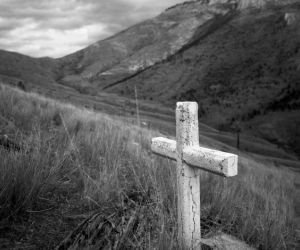
The slope is a hallowed cathedral to young souls, with cement crosses marking the locations where the smokejumper’s bodies were found (one of the crosses, noting where smokejumper Hellman died, is mentioned in the passage). Maclean knows the physical exertion to simply be on the slope can be fatal. Another person mentioned in the passage (Gisborne, a fire researcher) previously died on the slope while doing research, having suffered a heart attack. Maclean is twenty years older than Gisborne was when he died. Maclean has no good reason to be climbing up Mann Gulch at his age.
Maclean writes, “Approaching Mann Gulch from Rescue Gulch is approaching Mann Gulch from the side, and Mann Gulch can't be seen until you look down into it after reaching the top of the ridge. However, if you know where to look from the mouth of Rescue Gulch, you can see Hellman's cross close to the top. It is up this gulch that Jansson took Gisborne, and Jansson, having been head of the rescue crew, knew where Hellman's cross was and from the mouth of Rescue Gulch pointed it out to Gisborne, who took two hours getting there, stopping every hundred yards by prior agreement. Probably it was because Gisborne died of a heart attack on the way out that the others with me insisted I not try to make the climb, being twenty years older than Gisborne was when he died and, like him, having had heart problems. They even said they had been told in Missoula not to let me go. Finally, I had to get personal and tell them, "Look, there is a mountain downriver no farther than twelve miles from here by air that also looks over the Missouri. It was named by my wife when she was still a girl, and she named it Mount Jessie after herself, although she lived an otherwise modest life. At her request her ashes are there now. Nobody should feel bad if I should remain behind on one of these hills that looks her way.” Sallee reached over and took my pack off my shoulders, and we started climbing.”
I was, and remain, gobsmacked.
Neither Jessie, nor the mountain she named, appears anywhere in the book before this passage on page 188. How anyone just drops that truth into a paragraph on page 188 and goes on about his business with the “story” is a literary miracle.
Take that Yale University (Lonely Crowd) Press. University of my birthplace Press is now #1 and #2 on the podium.
Setting aside every other dumb thing I have done, I have climbed mountains I should not have attempted, and I am presently finding my way toward fire, rather than plotting a course away from it. As a hobby. For no objectively good reason, except someone has to do it. So the question is why?
Why did fifteen young men fly 120 miles to jump out of a C-47 into the wilderness to fight a fire that was not threatening anyone they knew, or anything they owned? Why did Maclean wax poetic about mortality and find comfort in his wife’s eternal presence on a mountain in the distance? Why do I set life on pause when the fire pager goes off? The answer is because they, and he, and I, couldn’t not. I can only speak for myself, but a life of faithful public service is either lived, or it is not. Not a lot of grey area, there.
Maclean had no good reason to be traversing the Mann Gulch slope that day at his age. He had a great reason; he had to be there. It was who he was. He knew it, and Jessie knew it, calling to him across the peaks and veil of mortality.
Self-identity is both complicated and simple. It is complicated in creation, and simple in execution. The crosses on the slope of Mann Gulch are most tragic in representing self-identity suspended in time. Young, athletic men – WWII vets, mostly -- serving the greater good consumed by a force beyond their power, before they could become who they might otherwise be. Before they could become who they would want to be after their audacious youth. The tragedy of opportunity, cut short.
But tragedy plays the long game too. A decade prior to saying no one should feel bad if he were to die on a particular hill, Maclean ended his first book with, “I am haunted by waters.” The particular waters he was haunted by were rivers. Rivers ... are time.
Mountains are challenges, and rivers are time. Time is all we have. Use it well.
Immerse yourself in consequence and climb until the end.